Analysis & Commentary · Environmental disclosure
CDP reporting: what it is and how it scores
Someone has asked you to disclose to CDP, and nothing you have read says plainly what that means.
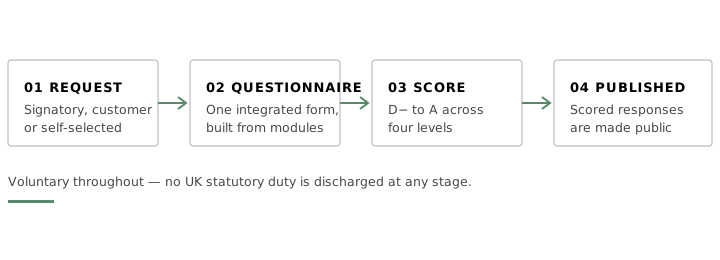
CDP is a voluntary environmental disclosure system run by a UK charity.
It is not a regulator, and answering it discharges no UK legal duty.
Whether you pay, whether you are scored and who sees the result all depend on who asked you — three separate questions CDP answers in three separate places.
This page puts them together, and then maps what the same data does for your UK statutory reporting.
Updated 22 August 2026
What CDP reporting is
CDP runs the largest environmental disclosure system in the world, and it is a platform rather than an authority.
Companies, cities, states and regions answer a questionnaire on climate change, water security and forests, and CDP scores and publishes the responses.
In 2025 more than 23,100 organisations disclosed through CDP, including over 22,100 companies representing more than half of global market capitalisation.CDP — Scores and A Lists
CDP Worldwide is a registered charity in England and Wales, number 1122330.CDP, Terms of Disclosure
In June 2026 CDP announced it will split into a Permira-backed commercial entity and a separate charitable CDP Foundation; as at August 2026 that change had not completed, and CDP says the 2026 disclosure cycle is unaffected.CDP, 11 June 2026 press release
A platform, not a regulator
This distinction carries the rest of the page.
CDP does not make rules, cannot fine you, and has no statutory power over any UK company.
It collects data because investors and customers ask it to, and its leverage is theirs, not its own.
For 2026, CDP's Capital Markets Signatories — over 540 financial institutions with more than US$110 trillion in assets — are requesting over 43,000 organisations to disclose.CDP, Disclosure 2026
That demand is why CDP reporting matters even though nothing about it is mandatory.
CDP disclosure: who actually asked you
Almost every question you have flows from this one, and most guides skip it.
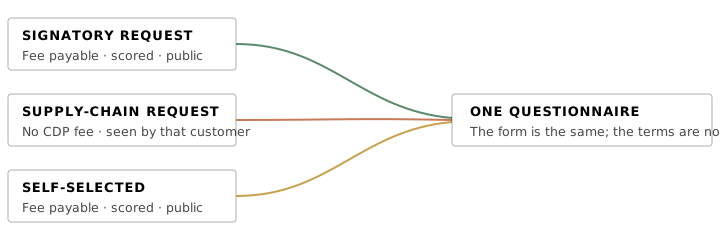
A request can come from CDP on behalf of its capital-markets signatories, from a customer running a supply-chain programme, or from nobody at all if you choose to disclose as a self-selected company.CDP, Disclosure 2026
Those three routes are not variations on a theme.
They differ on whether CDP charges you, on whether your response is eligible for a score, and on who is able to see what you submit.
Reading the request you were sent
The email itself usually tells you which route you are on.
A request naming CDP and referring to investors is a signatory request.
A request from a named customer, arriving through their procurement or sustainability team, is a supply-chain request.
If no one asked and you are considering disclosing anyway, you are self-selected — which is a real and ordinary route, not a lesser one.
The Carbon Disclosure Project, and why the name persists
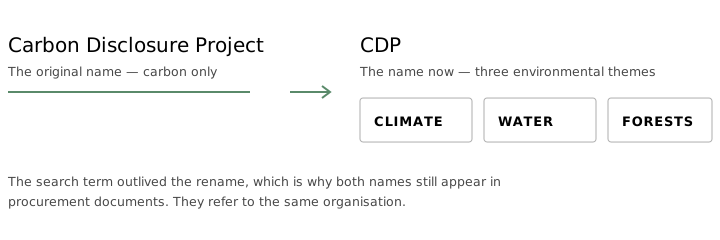
CDP was the Carbon Disclosure Project until it stopped being only about carbon.
The organisation dropped the long form as it added water security and forests, because the name had stopped describing what it did.
The search term did not follow, which is why you will still see the old name in procurement documents and internal policies years after CDP retired it.
Both refer to the same organisation, and nothing turns on which one your customer used.
Is CDP reporting mandatory?
No, and the more useful question is what declining actually costs you.
CDP is voluntary and sits outside the UK's statutory reporting regime.CDP, Terms of Disclosure
No UK law requires a CDP response, and no regulator penalises the absence of one.
What a non-response costs is commercial rather than legal, and it depends entirely on who asked and how much of your revenue sits behind them.
That is a judgement about your own customer relationships, and no page can make it for you — which is why there is no percentage anywhere in this section.
If you have never done this before
The first cycle is mostly a data-gathering exercise, not a writing one.
Most of the difficulty is discovering that energy, fuel and travel data lives in four systems owned by three teams.
The questionnaire itself is long but not obscure, and CDP publishes the guidance and the scoring methodology before the cycle opens.CDP, How to Disclose
A first response that is complete and honest scores better than an ambitious one with gaps in it.
That is not encouragement, it is how the ladder is built: the first level measures completeness, and you cannot skip it.CDP Help Centre, KA-01160
The 2027 cycle is already published, and it runs earlier in the year than 2026 did.
It opens on 14 April 2027 with a scoring deadline of 23 June 2027 and questionnaire closure on 25 August 2027.CDP, Disclosure Hub 2027
If you plan your data collection around the 2026 calendar you will be roughly three months late for 2027.
So the real question is not what CDP is
It is what it wants from you
Four requesters, four different obligations
Who asked you decides three separate things, and CDP publishes them in three separate places.
Whether an admin fee is payable, whether the response is eligible for a score, and who can see what you submit are independent questions.
Select the route you are actually on.
Reading that answer back
A fee and a score are not the same commitment.
The fee is payable before submission, so it lands in the cycle you disclose in, not the one after.CDP Help Centre, KA-01037
A score, once assigned, is published and becomes part of how the market reads you.
There is one paid escape from the scoring deadline, and it is limited.
CDP offers a small number of On-Demand Extensions at its own discretion, which move the scoring deadline to 30 September 2026 and must be requested by 29 September.CDP, Terms of Disclosure
It is an extension of the scoring cut-off, not of the questionnaire closure date, so it buys a fortnight rather than a reprieve.
Carbon Disclosure Project reporting: the questionnaire
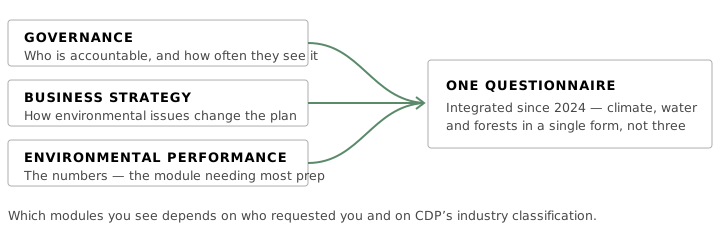
Since 2024 there is one integrated corporate questionnaire, not three separate forms.
Climate change, water security and forests were combined into a single questionnaire built from modules.CDP, framework alignment
Which modules you see depends on who requested you, on CDP's industry impact classification, and on your own assessment of what is relevant.
What the modules ask for
The structure is consistent even where the content is not.
Governance asks who is accountable and how often they see the data.
Business Strategy asks how environmental issues change what you plan to do.
Environmental Performance asks for the numbers, and it is the module that needs the most preparation.
Climate change, water security and forests
You disclose on the themes that are switched on for you.
Climate is the theme almost every requested company answers.
Water security and forests are driven by sector and by what the requester asked for.
CDP's 2026 questionnaire widened this further, adding ocean questions and broadening the forests and natural-ecosystems coverage.CDP, Disclosure 2026
The water security, plastics and climate questions were revised in the same round, with adaptation and resilience layered into the climate module.CDP, Disclosure 2026
There is also a shorter SME questionnaire, which in 2026 gained forests and water security alongside climate.CDP, Disclosure 2026
If you were requested and you are small, check which questionnaire you have been pointed at before you plan around the corporate one.
Carbon disclosure: Scope 1, 2 and 3
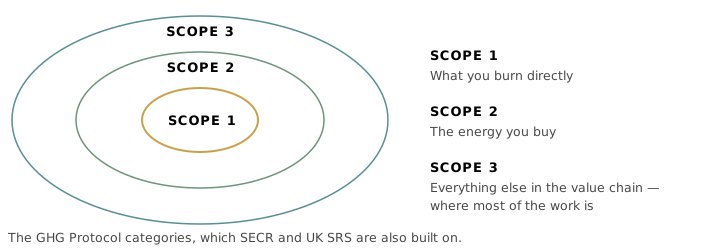
The emissions categories CDP asks for are the GHG Protocol's, not CDP's own.
Scope 1 is what you burn directly.
Scope 2 is the energy you buy.
Scope 3 is everything else in your value chain, and it is where most of the work is.GHG Protocol, Scope 3 Standard
Because SECR and UK SRS are built on the same categories, this is the part of a CDP response that travels furthest.
What you need before you can answer
Gather it before the cycle opens, not during it.
Energy and fuel consumption for the reporting year, by site.
Business travel, and enough of your purchased goods and services data to attempt Scope 3.
The governance record showing who reviewed the numbers and when.
Scope 3 is where most first-time responses thin out, and it is also the part that carries furthest into your statutory reporting.
You are not expected to have all fifteen Scope 3 categories in year one, and saying which ones you have measured is worth more than a total with no basis.
The GHG Protocol's Scope 3 standard is the reference for what those categories are.GHG Protocol, Scope 3 Standard
How CDP scoring works
Four consecutive levels, each one gating the next.
A company reaches Leadership by clearing the three levels below it, not by scoring well on a single measure.CDP Help Centre, KA-01160
The bands, in words
Each band measures something different from the one below it.
Disclosure measures completeness — whether the data is there at all.
Awareness measures understanding of how environmental issues meet the business.
Management measures evidence of action, and Leadership measures verified, sector-leading practice.CDP Help Centre, KA-01160
There is no F
A great deal of published guidance still says non-responders get an F, and CDP does not issue one.
A requested company that does not respond, or that provides insufficient information to be scored, is marked “Did not disclose”.CDP Help Centre, KA-01160
A response submitted after the scoring deadline may not be eligible for scoring at all.CDP Help Centre, KA-01160
Neither is a grade, and neither is a judgement on environmental performance.
Both simply record that CDP had nothing scoreable to assess.
The carbon disclosure project report and the A List
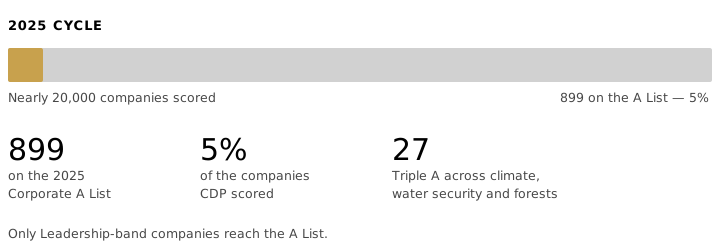
The A List is the top of the scoring ladder, and it is small.
899 companies made the 2025 Corporate A List, which is 5% of the nearly 20,000 companies scored.CDP — Scores and A Lists
27 achieved a Triple A across climate, water security and forests.CDP — Scores and A Lists
What CDP reporting costs
CDP publishes its admin fee, and almost every cost figure you will see elsewhere is not CDP's.
For a UK-headquartered organisation the 2026 fee is Foundation £2,450 or Enhanced £5,985, exclusive of applicable taxes.CDP FAQs, 2026 fee table
The Essential tier is not available in the UK, Europe, North America or Japan.CDP FAQs
The fee is payable before submission and rose around 5% globally in 2026, which CDP attributes to inflation and operational costs.CDP Help Centre, KA-01037
The equivalent figures elsewhere are €2,975 and €7,200 in Europe, and US$3,250 and US$7,650 in North America.CDP FAQs, 2026 fee table
What the Enhanced tier adds is access to a wider set of disclosers' data — up to 100 — along with priority event registration and a ten-peer benchmarking report.CDP, Terms of Disclosure §3.1
Whether that is worth the difference depends on how much you intend to use the benchmarking, and it is not a question CDP answers for you.
Everything beyond the fee — consultant time, software, internal effort — depends on the state of your data and is not something CDP publishes.
We have left those figures out rather than repeat someone else's estimate of them.
Who pays, and who is exempt
The charged group is narrower than most summaries suggest.
The admin fee applies to companies requested by CDP's Capital Markets Signatories, to self-selected companies, and to public authorities.CDP Help Centre, KA-01037
Cities, states and regions are exempt.CDP Help Centre, KA-01037
What this does for your UK obligations
This is the part no competing page covers, and it is the reason the data is worth gathering properly.
A CDP response is not a filing and discharges no UK duty.
But the emissions data underneath it is the same data SECR, UK SRS and the FCA's proposals are built on.
Select a regime to see what carries across and what does not.
CDP and SECR
The emissions overlap is large; the format overlap is not.
An unquoted company or LLP is in SECR scope where it exceeds two of turnover £36m, balance sheet total £18m and 250 employees, in the financial year and the one before it.SI 2008/410, Schedule 7
Scope 1 and Scope 2 carry across almost directly.
SECR additionally wants a UK energy-use figure and an intensity ratio, reported in your annual accounts rather than submitted to a platform.
CDP, IFRS S2 and UK SRS
These share a lineage, which is why the data travels.
CDP has used IFRS S2 as the foundational baseline for its climate questions since 2024.CDP, framework alignment
IFRS S2 fully incorporates the TCFD recommendations, and UK SRS S2 is the UK's endorsement of IFRS S2.
A company already answering CDP has gathered much of what UK SRS asks about.
What CDP does not do for you
Worth stating plainly, because the overlap invites the opposite conclusion.
A CDP response is not a statutory filing and satisfies no UK reporting obligation.
It is not assured unless you have had it assured separately.
And a good score is not evidence of compliance with anything.
The record
Everything below is the reference material this page has always carried.
Reference tables
| Theme | What it covers | How it is asked |
|---|---|---|
| Climate change | Governance, strategy, risks and opportunities, targets and Scope 1, 2 and 3 emissions | Integrated corporate questionnaire |
| Water security | Water-related risks, dependencies, governance and performance | Integrated questionnaire; theme opt-in |
| Forests | Deforestation risk in commodity supply chains and related governance | Integrated questionnaire; theme opt-in |
| Level | Band | What it signals |
|---|---|---|
| Leadership | A / A− | Best practice: ambitious strategy, verified progress, sector-leading action |
| Management | B / B− | Evidence of action and processes to manage environmental issues |
| Awareness | C / C− | Understanding of how environmental issues affect the business |
| Disclosure | D / D− | Completeness of reporting — data provided but not yet acted on |
| Did not disclose | No score | Requested but did not respond, or gave insufficient information to be scored |
| Milestone | Timing (2026) | What it means |
|---|---|---|
| Questionnaire & guidance published | Week of 20 April | Prepare responses against the 2026 framework |
| Scoring methodology published | Week of 27 April | See how each answer will be scored |
| Disclosure cycle opens | June | Submit through the CDP Portal |
| Scoring deadline | 16 September | Cut-off for a response to be scored |
| Questionnaire closure | 28 October | Responses locked; no further edits |
Where to go next
The CDP cluster. The reporting timeline sets out both the 2026 and 2027 cycles date by date. CDP scores goes deeper on the bands than this page does, and CDP cost covers the fee in its own right. CDP and reporting standards and the CDP framework guide cover the alignment questions, and CDP environmental reporting covers water and forests rather than climate alone.
The UK obligations this data feeds. SECR requirements and streamlined energy and carbon reporting are where the Scope 1 and 2 numbers go. UK SRS requirements and climate scenario analysis are the standards side, TCFD vs UK SRS explains the lineage, and TCFD reporting covers the recommendations IFRS S2 absorbed.
The wider carbon picture. Scope 3 emissions reporting is the category most first responses thin out on. Carbon reporting requirements and ESG reporting requirements map the whole UK landscape, ESOS Phase 4 is the energy-audit regime running alongside it, and biodiversity reporting is where the forests theme leads. Science-based targets covers the initiative CDP is a founding partner of.
Help with any of it. Carbon compliance consultancy, sustainability consultancy and carbon reporting software, or the general FAQ and the homepage.
Our read: CDP is best understood as the market’s data plumbing for environmental disclosure, not a compliance obligation. The figures that travel with most CDP “cost” guides — total implementation budgets, consultant ranges — are not published by CDP. The one figure CDP does publish is the admin fee, and it is in what CDP reporting costs. Treat any other cost claim as unverified unless it cites a primary source.
CDP reporting: frequently asked questions
What is CDP?
CDP is a global, voluntary environmental disclosure system, at present run by the charity CDP Worldwide (registered charity no. 1122330); in June 2026 CDP announced it will split into a Permira-backed commercial entity and a separate charitable CDP Foundation, a change not yet complete as at August 2026. Companies, cities, states and regions respond to a questionnaire covering climate change, water security and forests, and CDP scores and publishes the results. In 2025, over 23,100 organisations disclosed through CDP, including more than 22,100 companies representing more than half of global market capitalisation. CDP describes itself as the world’s largest environmental disclosure system.
Is CDP reporting mandatory?
No. CDP is a voluntary disclosure platform. Companies respond either because a customer, investor or supply-chain partner has requested it, or because they choose to disclose voluntarily as a self-selected company. It is separate from the UK’s statutory regime, but the corporate questionnaire is aligned with IFRS S2, which underpins UK SRS S2, so the data collected can support mandatory climate reporting.
How does CDP scoring work?
CDP scores each response across four consecutive levels: Disclosure (D/D−), Awareness (C/C−), Management (B/B−) and Leadership (A/A−). The bands track a company’s progress from simply disclosing data, through understanding and managing its environmental impacts, to demonstrating leadership. A company that is requested to disclose but does not respond, or provides insufficient information to be scored, is marked “Did not disclose” rather than given a grade; a response submitted after the scoring deadline may not be eligible for scoring at all. Only Leadership-level (A) companies appear on CDP’s annual A List.
What is the CDP deadline for 2026?
CDP’s 2026 disclosure cycle opens in June and runs for around four months. The scoring deadline — the cut-off for a response to be eligible for a CDP score — is 16 September 2026. Edits can still be made until the questionnaire closure date of 28 October 2026, after which responses are locked. Always check CDP’s Disclosure Hub for the confirmed dates, as CDP can revise them.
What does CDP cover — climate, water and forests?
CDP runs three environmental themes: climate change, water security and forests. Since 2024 these sit within a single integrated corporate questionnaire built around modules such as Governance, Business Strategy and Environmental Performance, rather than three separate forms. Companies disclose on the themes that are relevant to them, based on a request, CDP’s industry impact classification, or their own assessment.
How does CDP relate to UK SRS, IFRS S2 and TCFD?
CDP aligned its corporate questionnaire with the ISSB’s IFRS S2 climate standard in 2024 and uses IFRS S2 as the foundational baseline for climate disclosure. IFRS S2 fully incorporates the recommendations of the Task Force on Climate-related Financial Disclosures (TCFD). Because UK SRS S2 is the UK’s endorsement of IFRS S2, responding to CDP can help a company gather and structure much of the same climate data it will need for UK SRS reporting — though CDP and UK SRS remain distinct.
How much does CDP reporting cost in the UK?
CDP’s published admin fee for a UK-headquartered organisation in 2026 is £2,450 for the Foundation tier or £5,985 for the Enhanced tier, exclusive of applicable taxes. The Essential tier is not available in the UK, Europe, North America or Japan. The fee is payable before submission and rose by around 5% globally in 2026. Costs beyond the fee — internal time, data collection, software or consultants — are not published by CDP and vary with the state of your data, so treat any specific figure you see elsewhere as unverified unless it cites a primary source.
Do I have to pay if only my customers asked me to disclose?
CDP’s admin fee applies to companies requested to disclose by CDP’s Capital Markets Signatories, to self-selected companies, and to public authorities. Cities, states and regions are exempt. A supply-chain request from a customer is a different route from a signatory request, so check which one you have received before assuming a fee is due, and confirm against CDP’s own fee guidance because CDP sets and revises these terms.
What happens if I miss the CDP deadline or do not respond?
There is no F grade. A requested company that does not respond, or that provides insufficient information to be scored, is marked “Did not disclose”. A response submitted after the scoring deadline may not be eligible for scoring at all. Neither status is a grade and neither is a reflection of a company’s environmental stewardship — both simply record that CDP had nothing scoreable to assess. The consequences that do follow are commercial rather than regulatory, since the request came from an investor or customer rather than from a regulator.
When is the 2027 CDP disclosure cycle?
CDP published its 2027 cycle calendar in July 2026. The 2027 disclosure window opens on 14 April 2027 with a scoring deadline of 23 June 2027, which is materially earlier in the year than the 2026 equivalent. Our CDP reporting timeline sets out both cycles side by side, including the shorter 2027 response window and what it means for organisations that plan their data collection around the older calendar.
Sources
- CDP — Scores and A Lists. 22,100+ companies disclosed in 2025; 899 on the 2025 Corporate A List, 5% of nearly 20,000 scored; 27 Triple A.
- CDP Help Centre — Understand your score. The four scoring levels, and the “Did not disclose” status that replaced the F.
- CDP FAQs. The 2026 disclosure admin fee table, including the UK figures.
- CDP Help Centre — the disclosure admin fee. Who is charged, who is exempt, and when it is payable.
- CDP — Terms of Disclosure. Scoring deadline 16 September 2026; questionnaire closure 28 October 2026.
- CDP — How to Disclose. Cycle timing and the publication of guidance and scoring methodology.
- CDP — Disclosure 2026. The 2026 cycle, signatory numbers and the questionnaire changes.
- CDP — Alignment with disclosure frameworks. IFRS S2 as the foundational baseline since 2024.
- GHG Protocol — Corporate Value Chain (Scope 3) Standard. The emissions categories CDP, SECR and UK SRS share.
- SI 2008/410, Schedule 7. The SECR qualifying conditions and thresholds.
- FCA CP26/5. Proposed mandatory disclosure scope and the cost-benefit analysis.
- KPMG — CDP releases 2026 questionnaires and deadlines. Secondary summary, retained as further reading.
Work out what you actually owe
CDP is one request among several, and the data behind it feeds obligations that are not voluntary at all.
See how the UK regimes fit together →
Or read the CDP reporting timeline, the scoring detail, or what SECR requires.
Every figure, date, threshold and monetary value on this page carries an inline citation to a primary source.
hello@uksrs.org.uk · Fractional Quest Ltd · Company No. 17322105 · 71–75 Shelton Street, London WC2H 9JQ · © 2026 Fractional Quest Ltd