UK SRS timeline — every date, and which ones are fixed
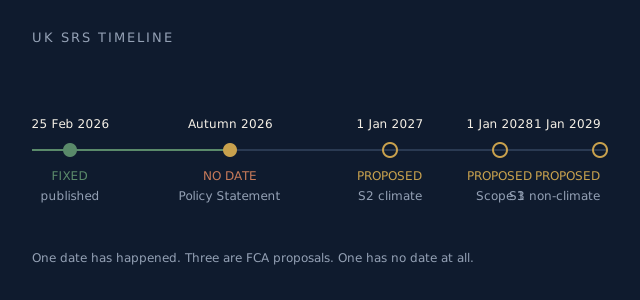
One date on this timeline has actually happened. On 25 February 2026 the Department for Business and Trade published UK SRS S1 and S2, for voluntary use by anyone who wants them.
Everything after that is a proposal. The FCA has consulted on requiring listed companies to report against UK SRS S2 for accounting periods beginning on or after 1 January 2027 — and has not yet made the rule. Its Policy Statement is expected in autumn 2026.
- 25 February 2026 UK SRS S1 and S2 published, for voluntary use Happened
- 20 March 2026 The FCA’s CP26/5 consultation closed Happened
- Autumn 2026 FCA Policy Statement expected — no date announced Undecided
- 1 January 2027 First accounting periods the proposed S2 rules would cover Proposed
- 1 January 2028 Scope 3 relief would end under the proposal Proposed
- 1 January 2029 Non-climate S1 relief would end under the proposal Proposed
Three of these six are proposals in a consultation the FCA has not yet answered.
The UK SRS timeline has one date on it that has happened, and it is not a deadline
Almost every summary of the UK SRS timeline prints 1 January 2027 as if it were settled. It is not settled.
The distinction is not pedantry. A proposed date can move, and the difference between a published rule and a consultation the regulator has not yet answered is the difference between a plan and a bet.
What has actually happened
25 February 2026. DBT published UK SRS S1 and UK SRS S2, having assessed and endorsed the ISSB’s IFRS S1 and IFRS S2 with a short list of UK modifications. They are available from that date, to any entity that wants to use them. DBT, UK SRS S1 and UK SRS S2
GOV.UK states the position in one sentence: the standards “are available for voluntary use, by any entity that chooses to do so.” GOV.UK, UK Sustainability Reporting Standards
30 January to 20 March 2026. The FCA consulted, in CP26/5, on replacing its existing TCFD-aligned listing rules with a requirement to report against UK SRS. The consultation closed on 20 March and no Policy Statement has followed. FCA, CP26/5
What has not happened
No rule has been made. No commencement date has been set in legislation. No entity in the United Kingdom is required by anything to report against UK SRS today.
The FCA’s own words are careful, and worth reading exactly as written: it will “aim to publish a Policy Statement in autumn 2026, subject to the final UK SRS, with the rules coming into force from 1 January 2027.” FCA, Sustainability reporting requirements
Aim. Subject to. Those are the two words that most timelines drop.
The UK SRS timeline end to end, and the eighteen quiet months in the middle
Nine milestones carry the UK SRS timeline, and three of them happened in a seven-week window in early 2026.
Then nothing. Between 20 March 2026 and the Policy Statement the FCA has not yet published, the regulatory record is empty.
Scroll, and the rail below moves through the nine in order. Each one names the document that states it and whether anyone has actually decided it.
The consultation proposes deleting the TCFD-aligned listing rules and requiring in-scope listed companies to report against UK SRS instead. FCA, CP26/5
DBT publishes both standards and the government response to the exposure-draft consultation. They are available for voluntary use from this date and carry no effective date of their own. DBT, UK SRS S1 and S2
The last date on the UK SRS timeline on which anything actually occurred. Everything after this point is expectation. FCA, CP26/5
The FCA’s reporting-requirements page, last updated 5 June 2026, still says only that it intends to publish a Policy Statement in autumn. FCA, Sustainability reporting requirements
No date has been announced, and the FCA qualifies it twice: it aims to publish, and the publication is subject to the final UK SRS. This is the single milestone that turns the rest of the timeline from proposal into rule. FCA, Sustainability reporting requirements
The FRC’s sustainability assurance standard is effective for engagements on information reported for periods beginning on or after 15 December 2026. It is the one date on this timeline set by a published standard rather than a proposal. FRC, ISSA (UK) 5000
CP26/5 proposes the rules come into force on 1 January 2027 and apply to accounting periods beginning on or after that date. A December year-end therefore reports first on FY2027, in 2028. CP26/5, chapter 8
CP26/5 proposes one year of relief from Scope 3 disclosure, so Scope 3 would bite for accounting periods beginning on or after 1 January 2028. The first annual reports carrying mandatory UK SRS S2 also land during 2028. CP26/5, chapter 8
CP26/5 proposes two years of relief from reporting non-climate matters under UK SRS S1, so wider sustainability reporting would bite for accounting periods beginning on or after 1 January 2029. CP26/5, chapter 8
Keep scrolling — the rail advances with you
Every card above restates a date that is set out again, with its source, in the milestone record below and in the primary sources. The rail is display, not navigation.
Fourteen milestones, and only ten of them have been decided by anyone
The record below carries fourteen dated milestones. Sorting them by who decided them rather than by when they fall is the fastest way to see what this timeline really is.
The instrument below takes any milestone on the page and tells you which of the three it is, and which document decides it. It reads the same published dates the record does and computes nothing else.
Sources for every milestone are named beside it in the record and listed in full under primary sources.
Every published milestone on the UK SRS timeline, in order
The UK SRS implementation record does not begin in 2026. It begins with the TCFD-aligned listing rules the proposal would replace.
Fourteen milestones, each with the document that states it, and each marked according to whether anyone has decided it.
Where a date is proposed, the word proposed is on it. Where nobody has set a date, it says so.
What actually happened on the one date that happened
DBT did three things on 25 February 2026, and only the first is usually reported.
It published UK SRS S1 and UK SRS S2 — the UK’s versions of the ISSB’s IFRS S1 and IFRS S2, assessed and endorsed for use in the United Kingdom. DBT, UK SRS S1 and S2
It published the government response to the exposure-draft consultation, which is where the UK modifications are set out and justified. DBT, Government response
And it made both standards available for voluntary use immediately, by any entity, in whole or in part.
Six UK modifications, and one of them changes this timeline
The government response lists the changes made on endorsement. Most are narrow. The one that matters to a timeline is the third: the removal of the effective-date clauses.
The others, briefly: references to SASB materials changed from “shall refer to and consider” to “may refer to”; the requirement to use the Global Industry Classification Standard removed from S2; the IFRS S1 relief allowing sustainability information to be published at a different time from the financial statements removed; the durations of the non-climate and Scope 3 reliefs removed; a new paragraph on financed emissions in S2; and two new paragraphs in S1 on the compliance statement and on the primacy of UK law and regulation.
Neither standard contains a start date, and that is deliberate
IFRS S1 and IFRS S2 carry effective dates. UK SRS S1 and UK SRS S2 do not, because the UK took them out.
The government response states the change plainly: the effective date has been removed from UK SRS S1, “meaning that entities can apply the Standard when they choose to do so, unless required by UK law or regulations”. DBT, Government response
The exposure draft had said the same thing prospectively: “Any effective date for application of this Standard will be set out in the relevant legislation or regulation.”
Why this is the most useful fact on the page
It means the question “when does UK SRS start?” has no answer inside the standards, and cannot have one.
The start date is whatever a regulator or a statute says it is, for the entities that regulator or statute covers. Today there is exactly one candidate — the FCA’s proposal — and it has not been made.
UK SRS S1 goes further and says so in the standard itself, at paragraph 73B: application is “subject to any rules, requirements, regulations or legislation” in the Companies Act 2006 or determined by the FCA. UK SRS S1
What the FCA has actually proposed, and what it has not
CP26/5 is a consultation paper. It proposes; it does not enact.
Read at the level of what it would change, there are three proposals, and the third is the one that turns UK SRS from a document into an obligation.
One — delete the TCFD rules
CP26/5 proposes to “delete our current TCFD-aligned climate disclosure rules”. The regime that has applied since 2021 would go. CP26/5
Two — require UK SRS instead
In-scope listed companies would report against UK SRS S2 for climate, and in time UK SRS S1 for wider sustainability matters.
Three — commence on 1 January 2027
CP26/5 says both things at once, and they are not the same thing: “Those rules would come into force on 1 January 2027”, and “The new rules would then apply to accounting periods beginning on or after 1 January 2027.” CP26/5, chapter 8
The first is when the rulebook changes. The second is which of your accounting periods the changed rulebook reaches.
“Autumn 2026” is an aim, and it carries a condition
The single most consequential item on the UK SRS timeline is the one nobody can put in a calendar.
The FCA’s formulation, unchanged on its reporting-requirements page as last updated on 5 June 2026: it will “aim to publish a Policy Statement in autumn 2026, subject to the final UK SRS, with the rules coming into force from 1 January 2027.” FCA, Sustainability reporting requirements
Three things that sentence does not say
It does not name a month within autumn, or a day.
It does not commit: aim is doing real work in a regulator’s sentence.
And subject to the final UK SRS was written before 25 February 2026, when the final standards did not exist. That condition has now been satisfied — which removes one of the two obstacles the FCA named, and leaves the other, which is simply the time it takes to answer a consultation.
What a company should do with a date it cannot get
Work backwards from the proposed 1 January 2027 commencement anyway, and treat the Policy Statement as the point at which your plan stops being contingent.
If the Policy Statement lands in, say, October 2026, an in-scope company with a December year-end has roughly ten weeks between knowing the final rules and beginning the first proposed in-scope period. That is the compression this timeline is really about, and it is why the preparation work below is worth starting before the rule exists.
Who the proposal would cover: around 600 companies, of which 515 would have to comply
The scope is narrower than most coverage suggests, and the numbers come from the FCA’s own cost-benefit analysis rather than from anyone’s estimate.
On the FCA’s analysis, “around 600 listed companies would be affected by our proposals”, and of those, “515 listed companies with listings in either the commercial companies, non-equity shares and non-voting equity shares, or transition categories will be required to comply”. CP26/5, cost-benefit analysis
That is UK Listing Rules categories 6, 16 and 22. The remaining 89 sit in categories 14 and 15 and get a different, lighter requirement — see secondary listings and depositary receipts.
Categories and requirements as proposed in CP26/5; the current TCFD requirement for category 6 sits at UKLR 6.6.6R(8).
Secondary listings and depositary receipts get a signpost, not a standard
Companies whose only UK listing is a secondary listing or a depositary receipt are in scope of the proposal, but not in scope of UK SRS reporting.
CP26/5 proposes removing the TCFD requirement for these categories and replacing it with a statement in the annual financial report setting out “Any climate and/or wider sustainability disclosure requirements… to which the company is subject in relation to equity shares in their primary overseas listing location”. CP26/5, chapter 9
The cost-benefit analysis describes the requirement the same way: disclosure of the rules that apply in the company’s primary listing location or place of incorporation, or which it voluntarily adopts.
The TCFD rules have been running since 2021, and the proposal would delete them
Anyone searching for a TCFD reporting requirements UK timeline is really asking two questions: what applies now, and what replaces it.
What applies now
For equity shares in the commercial companies category, UKLR 6.6.6R(8) requires a comply-or-explain statement that the company has included climate-related financial disclosures “consistent with the TCFD Recommendations and Recommended Disclosures”. FCA Handbook, UKLR 6.6
It has applied to premium listed commercial companies for accounting periods beginning on or after 1 January 2021, and to standard listed shares and depositary receipts for periods beginning on or after 1 January 2022. FCA, PS21/23
The requirement now sits across five listing categories. FCA, Sustainability reporting requirements
What would replace it
UK SRS S2 for the three reporting categories, and a signposting statement for the other two. The TCFD framework itself is not disappearing from the world — its recommendations are carried through into IFRS S2 and therefore into UK SRS S2 — but the FCA rule that names TCFD would go.
Until the Policy Statement is published, the TCFD rules remain the live obligation. That is the practical answer for the 2026 reporting year and it is the sentence most timelines leave out.
A fuller comparison of the two frameworks sits on TCFD vs UK SRS, and the current UK TCFD landscape on TCFD reporting.
1 January 2027 is not your date unless your year-end is 31 December
“Accounting periods beginning on or after 1 January 2027” means something different for every year-end, and the difference can be eleven months.
A company with a 31 December year-end would first report on the year ending 31 December 2027, in its 2027 annual report, published during 2028.
A company with a 31 March year-end would first report on the year ending 31 March 2029 — because its period beginning 1 April 2026 starts before the cut-off, and so does nothing until 1 April 2027.
That is not a loophole. It is how “periods beginning on or after” works, and it is why a single headline date is the wrong thing to plan against.
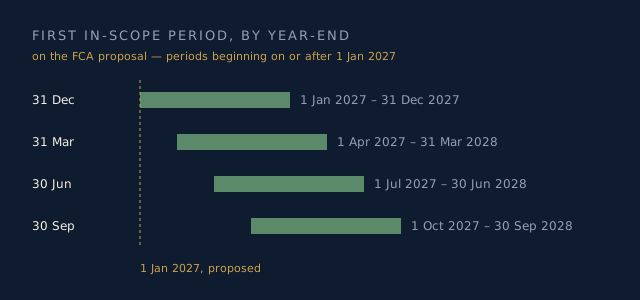
The instrument reads the proposed commencement in CP26/5, chapter 8 and applies it to a year-end you choose. It invents no dates and asserts no obligation — the rule it applies has not been made.
Scope 3 would arrive a year after everything else
CP26/5 proposes “non-disclosure under UK SRS S2 regarding Scope 3 emissions for a period of 1-year” from initial application. CP26/5, chapter 8
So on the proposed timetable, Scope 1 and Scope 2 would be disclosed for accounting periods beginning on or after 1 January 2027, and Scope 3 for periods beginning on or after 1 January 2028.
Two things the relief does not do
The measurement work itself is covered on UK SRS Scope 3 reporting and Scope 3 emissions reporting.
Wider sustainability reporting would not begin until 2029
UK SRS S1 covers sustainability-related risks and opportunities beyond climate. Under the proposal it would be the last thing to bite.
CP26/5 proposes “non-disclosure under UK SRS S1 for non-climate matters for a period of 2-years from initial application”. CP26/5, chapter 8
Two years from accounting periods beginning on or after 1 January 2027 puts non-climate reporting at periods beginning on or after 1 January 2029 — and a first report published during 2030 for a December year-end.
The mechanism inside the standard is UK SRS S1 paragraph E3, the climate-first provision. Using it costs the compliance statement: paragraph 73A says an entity using E3 “is not permitted to assert compliance with UK SRS S1 and shall disclose use of this provision instead”. UK SRS S1
So a company on the relief would report climate under S2 and say, in terms, that it is not claiming S1 compliance. That disclosure is itself part of the first-year output.
The one-year and two-year reliefs are not in the standards
This is the finding that changes how the rest of the timeline should be read, and it is stated in the government response rather than in either standard.
On endorsement, the UK removed the durations from the reliefs. The government response says the standards “no longer specify how long the reliefs for non-climate reporting and Scope 3 reporting may be applied”. DBT, Government response
What survives in the standards is the anchor, not the length: the reliefs are available “In the first annual reporting period in which an entity is required to use this Standard under UK law or regulations”.
Why this matters to a date
Every “Scope 3 from 2028, S1 from 2029” timeline on the internet — including the one this page replaces — is quoting the FCA’s proposed durations and attributing them to the standards.
They are the FCA’s, they are proposed, and they are set out in CP26/5 chapter 8. If the Policy Statement changes them — and a consultation exists precisely so that responses can change things — the standards will not need to be amended at all, because the standards never carried the numbers.
Two consequences follow. The 2028 and 2029 dates are more likely to move than the 2027 one, because they are pure rule-making rather than a commencement date the FCA has repeated in three places. And a company outside the FCA’s perimeter that adopts UK SRS voluntarily gets the reliefs with no duration attached, because nothing has made it “required to use” the standard in the first place.
Sustainability disclosures must be published on the same day as the accounts
IFRS S1 allowed an entity to publish sustainability information later than its financial statements. The UK removed that relief on endorsement.
UK SRS S1 paragraph 64 is one sentence: “An entity shall report its sustainability-related financial disclosures at the same time as its related financial statements.” UK SRS S1
The government response records the change as the “removal of the transitional relief in IFRS S1 that allowed reporting entities to publish sustainability information at a different time to financial statements”.
What this does to the plan
It collapses the sustainability reporting calendar into the financial reporting calendar, which is already the tightest calendar a listed company has.
There is no catch-up window.
For most in-scope companies this is the single biggest practical consequence on the whole timeline, and it is a decision the UK has already taken — it does not depend on the Policy Statement at all.
How long a first UK SRS report actually takes, counted backwards from your year-end
“How long does a sustainability statement take to complete” is the question this page gets asked most often, and the honest answer is that it is not one duration.
It is a set of dependencies that have to be finished in a particular order, and the last of them has to land on the day the accounts do.
The instrument below takes your year-end and the proposed commencement date and lays out what has to be true, and when, for the first in-scope report. It is a planning aid built on published dates — it invents no durations for your organisation and it recommends nothing.
No comparatives in the first period
UK SRS carries first-period relief from comparative information, and CP26/5 restates it: “In accordance with the UK SRS, listed companies are not required to disclose comparative information for the first accounting period” in which the disclosures are made. CP26/5
This matters to a timeline in a way that is easy to miss. Without it, a company facing a first proposed in-scope period beginning 1 January 2027 would need a complete, standard-quality 2026 data set as well — which would move the real start of the work back a full year.
Which GHG Protocol, and the first-year escape hatch
UK SRS S2 names its measurement basis explicitly, and the UK did not change it.
Scope 1 and 2 are measured in accordance with the “Greenhouse Gas Protocol: A Corporate Accounting and Reporting Standard (2004)”, and Scope 3 in accordance with the “Greenhouse Gas Protocol Corporate Value Chain (Scope 3) Accounting and Reporting Standard (2011)”. UK SRS S2
A first-year relief lets an entity use a method other than the 2004 standard, which exists for companies already reporting on another basis — typically a jurisdiction-mandated one.
The government response describes it as a relief “related to the use of a method other than the ‘Greenhouse Gas Protocol: A Corporate Accounting and Reporting Standard (2004)’ in the first year of reporting”.
For a UK company already reporting under SECR the practical work is smaller than it looks: SECR already runs on the GHG Protocol and the DESNZ conversion factors. DESNZ, 2026 conversion factors
The factor set and what changed in 2026 sits on UK emissions factors; the SECR overlap on SECR.
Assurance has its own dates, and one of them is fixed
The assurance track runs alongside the reporting track and is further ahead of it, which is the opposite of what most people assume.
The standard exists
The FRC issued ISSA (UK) 5000 in November 2025. It is effective for assurance engagements on sustainability information reported for periods “beginning on or after December 15, 2026 or as at a specific date on or after December 15, 2026”, and “Earlier application of this ISSA (UK) is permitted”. FRC, ISSA (UK) 5000
That 15 December 2026 date is not a proposal. It is the effective date of an issued standard, and it lands two weeks before the FCA’s proposed commencement.
The oversight regime is voluntary, and not statutory
The government’s response of 30 January 2026 confirmed it would “move forward with plans to establish a voluntary oversight regime for sustainability assurance in the UK”, and that “The regime will be operated by the FRC”. DBT, Assurance government response
It is voluntary because the legislation that would have made it statutory is not coming: the response records that “the government has since taken the decision not to proceed with the Audit Reform Bill”, and that legislation would follow “as and when Parliamentary time allows”.
Nothing in CP26/5 requires assurance of UK SRS disclosures. A company obtaining assurance in 2027 is doing so because its board or its investors want it, not because a rule says so — and it should build the extra weeks into the plan accordingly, because the same-day publication rule gives it nowhere to put them.
Private companies: no date, no threshold, and a consultation that has not appeared
The most common misreading of the UK SRS timeline is that it applies to companies generally. On the current record it does not apply to anyone at all, and the only proposal on the table covers listed companies.
The government response parked private companies in a separate programme: the government “will consider whether to require private companies to report information in accordance with UK SRS as part of that exercise”, the exercise being Modernising Corporate Reporting. DBT, Government response
It said the MCR consultation would come “shortly” and “later this year”. As at 19 August 2026 no such consultation has been published on GOV.UK.
Respondents asked for “‘economically-significant private entities’ (or companies) be clearly defined”. No definition and no threshold has been set. Any turnover or employee figure you see attached to UK SRS and private companies is somebody’s guess.
Transition plans: consulted on in 2025, still unanswered
The government consulted on climate-related transition plan requirements between 25 June and 17 September 2025, covering UK-regulated financial institutions and FTSE 100 companies. GOV.UK, Transition plan requirements
Eleven months after it closed, the consultation page still reads “We are analysing your feedback.”
Two options were consulted on: requiring entities to “explain why they have not disclosed a transition plan”, or requiring them to “develop a transition plan and disclose this”. GOV.UK, Implementation routes
No implementation date was floated in the consultation. If you have seen a transition-plan timeline with dates on it, those dates are not in the government’s document.
The link to UK SRS is real but indirect: the UK SRS government response notes respondents suggesting “that UK SRS S2 was a suitable foundation for transition plans, with potential amendments”. UK SRS S2 already requires disclosure of a transition plan where an entity has one; a separate requirement to have one is what remains undecided.
The standards are usable today, and using them is the only way to move the date forward
The timeline’s awkward shape — one real date, then a wait — has one constructive reading.
Both standards are available now, to any entity, “in whole or in part, as they see fit”. Nothing stops a company running a full UK SRS S2 dry run on its 2026 year. GOV.UK, UK Sustainability Reporting Standards
For an in-scope listed company that is not enthusiasm, it is arithmetic: if the Policy Statement lands in late autumn 2026, the gap between knowing the final rules and starting the first period they cover is measured in weeks.
What a dry run buys you
The disclosure set itself is on UK SRS requirements, the S2 climate detail on UK SRS S2, and a step-by-step route on the implementation guide.
Four ways 1 January 2027 could still move
A page that marks dates as proposed owes the reader an account of how a proposed date actually changes.
The Policy Statement slips
Autumn 2026 is an aim. A regulator that publishes final rules in, say, December 2026 for a commencement on 1 January 2027 gives in-scope companies effectively no notice, which is itself an argument for moving the commencement.
The consultation responses move it
Consultations exist so that responses can change proposals. The commencement date and the relief durations were both consulted on, and both can come back different.
The reliefs move without the commencement moving
This is the most likely change and the least reported, because the relief durations live in the FCA’s rules rather than in the standards — see where the reliefs live. Extending Scope 3 relief to two years would change 2028 and leave 2027 untouched.
Something upstream changes
The standards themselves are not fixed forever: they are UK endorsements of ISSB standards, and the ISSB continues to work. A material amendment upstream would have to be assessed and endorsed here first.
Where the UK SRS timeline stands, on 19 August 2026
UK SRS S1 and S2 exist and are available for voluntary use. Neither carries an effective date. No UK entity is required to report against either.
The FCA has proposed — not made — rules requiring 515 listed companies to report against UK SRS S2 for accounting periods beginning on or after 1 January 2027, with Scope 3 a year later and non-climate S1 two years later.
Its Policy Statement is expected in autumn 2026, with no date announced. Until it lands, the TCFD-aligned listing rules remain the live obligation and 1 January 2027 remains a proposal.
The dates worth writing down
The UK SRS timeline in full
Every milestone on the page, with what each one means for an organisation planning against it, and who decided it.
What is fixed, what is proposed, and what nobody has decided
The same record sorted by who decided it, which is the sort that actually tells you how much of this timeline you can rely on.
Your first in-scope period, by year-end
Applying “accounting periods beginning on or after 1 January 2027” to the four most common UK year-ends, on the proposal as consulted on.
More UK SRS coverage on SRS Report
UK SRS: the complete guide
What the standards are, who they cover, and how they got here.
DeadlinesIs there a UK SRS deadline?
The deadline question specifically, and what missing one would mean.
ClimateUK SRS S2 explained
The climate standard that would bite first, disclosure by disclosure.
RequirementsUK SRS requirements
The full disclosure set, and what each one asks for.
RegulatorUK SRS and the FCA
CP26/5 in detail, and how the listing rules would change.
ProcessThe UK SRS consultation
What was asked, what was answered, and what changed on endorsement.
ScopeWho needs UK SRS?
The 515, the 89, and everyone the proposal does not reach.
EndorsementUK SRS endorsement
How IFRS S1 and S2 became UK SRS, and the six modifications.
CompareTCFD vs UK SRS
What carries over from the regime being replaced, and what does not.
UK SRS timeline: frequently asked questions
When does UK SRS become mandatory?
It has not been made mandatory, and no date has been set.
The FCA has proposed, in CP26/5, that in-scope listed companies report against UK SRS S2 for accounting periods beginning on or after 1 January 2027. That consultation closed on 20 March 2026 and the FCA has not yet published its Policy Statement.
The FCA says it aims to publish that Policy Statement in autumn 2026, subject to the final UK SRS, with the rules coming into force from 1 January 2027. FCA, Sustainability reporting requirements
Until then, UK SRS is available for voluntary use only, and the existing TCFD-aligned listing rules remain the live obligation for listed companies.
Is 1 January 2027 a deadline?
No. It is the proposed start of the first accounting periods the rules would cover.
A company with a 31 December year-end would first report on the year ending 31 December 2027, and would publish that report during 2028.
UK SRS disclosures would sit inside the annual financial report, so the filing date is the annual report’s filing date, not a separate UK SRS deadline. CP26/5, chapter 8
When were UK SRS S1 and S2 published?
25 February 2026, by the Department for Business and Trade, alongside the government response to the exposure-draft consultation.
Both are available for voluntary use from that date, by any entity, in whole or in part. DBT, UK SRS S1 and S2
Do UK SRS S1 and S2 have an effective date?
No, and that is a deliberate UK modification.
The government response records the removal of the effective-date clauses, meaning entities can apply the standards when they choose to, unless required by UK law or regulations.
UK SRS S1 paragraph 73B makes the same point inside the standard: application is subject to any rules, requirements, regulations or legislation in the Companies Act 2006 or determined by the FCA. DBT, Government response
Who would have to report under the FCA’s proposals?
On the FCA’s own analysis, around 600 listed companies would be affected, and 515 of them — those in the commercial companies, non-equity and non-voting equity, and transition categories — would be required to comply.
The remaining 89, in the secondary listing and depositary receipts categories, would instead disclose which climate or sustainability requirements apply in their primary listing location. CP26/5, cost-benefit analysis
No private company is covered by any current proposal.
When would Scope 3 emissions have to be disclosed?
Under the proposal, for accounting periods beginning on or after 1 January 2028 — one year after the rest of UK SRS S2.
The one-year figure is the FCA’s, set out in CP26/5, not the standard’s. The UK removed the durations from the reliefs when it endorsed the standards, so UK SRS S2 itself does not say how long Scope 3 relief lasts. DBT, Government response
The relief is from disclosure, not from measurement.
When would wider sustainability reporting under UK SRS S1 begin?
Under the proposal, for accounting periods beginning on or after 1 January 2029 — two years of relief from reporting non-climate matters.
A company using that relief reports climate under UK SRS S2 and, under S1 paragraph 73A, is not permitted to assert compliance with UK SRS S1; it must disclose that it has used the provision instead. CP26/5, chapter 8
Can UK SRS disclosures be published after the annual accounts?
No. The UK removed the IFRS S1 transitional relief that allowed it.
UK SRS S1 paragraph 64 requires an entity to report its sustainability-related financial disclosures at the same time as its related financial statements. UK SRS S1
For most in-scope companies this is the biggest practical consequence of the whole timetable, and it applies whatever the FCA decides, because it is written into the standard rather than into a rule.
Do UK SRS disclosures have to be assured?
No proposal requires assurance of UK SRS disclosures.
The FRC’s assurance standard, ISSA (UK) 5000, exists and is effective for engagements on sustainability information reported for periods beginning on or after 15 December 2026, with earlier application permitted. FRC, ISSA (UK) 5000
The oversight regime for assurance providers is voluntary and operated by the FRC. The government confirmed in January 2026 that it would not proceed with the Audit Reform Bill, so a statutory regime awaits Parliamentary time. DBT, Assurance government response
Will UK SRS apply to private companies, and when?
Nobody has decided, and no date exists.
The government response of 25 February 2026 said it would consider whether to require private companies to report in accordance with UK SRS as part of the Modernising Corporate Reporting programme, and that it planned to consult on that programme shortly.
As at 19 August 2026 no such consultation has been published, and no definition of an “economically significant” private entity has been set. Any turnover or employee threshold attributed to UK SRS and private companies is not a government figure. DBT, Government response
The timeline’s vocabulary, in plain English
Several of the words in this area mean something narrower than the everyday words they resemble, and one of them — “mandatory” — is the reason most published UK SRS timelines are wrong.
- UK SRS
- UK Sustainability Reporting Standards. S1 and S2, published by DBT on 25 February 2026, being the UK’s endorsed versions of the ISSB’s IFRS S1 and IFRS S2.
- Endorsement
- The UK process of assessing an international standard and adopting it, with or without modification. UK SRS carries six modifications to the IFRS originals.
- Effective date
- The date from which a standard applies. UK SRS S1 and S2 have none: the UK removed the clauses, so the date is set by whatever regulation or legislation requires the standard.
- CP26/5
- The FCA consultation paper of 30 January 2026 proposing that listed companies report against UK SRS in place of the TCFD-aligned listing rules. Closed 20 March 2026.
- Policy Statement
- The document in which the FCA responds to a consultation and makes final rules. The UK SRS one is expected in autumn 2026; until it is published, CP26/5 is a proposal.
- Accounting period beginning on or after
- The standard commencement formula. It reaches your first period that starts on or after the date, which for a 31 March year-end is fifteen months later than for a 31 December one.
- Non-disclosure relief
- Permission not to disclose something the standard otherwise requires. UK SRS carries reliefs for Scope 3 and for non-climate matters; the UK removed their durations, which now live only in the FCA’s proposed rules.
- UKLR category
- The UK Listing Rules category a listing sits in. Categories 6, 16 and 22 would report against UK SRS; 14 and 15 would make a signposting statement instead. The premium/standard distinction is retired.
- Comply or explain
- The form of the current TCFD listing rule: state whether disclosures are consistent with the TCFD recommendations, and if not, explain why. CP26/5 proposes to delete it.
- ISSA (UK) 5000
- The FRC’s assurance standard for sustainability information, issued November 2025, effective for engagements on periods beginning on or after 15 December 2026.
- Modernising Corporate Reporting
- The DBT programme in which any extension of UK SRS to private companies would be considered. Promised “shortly” in February 2026; not published as at 19 August 2026.
Primary sources
Every date and figure on this page is linked to the document that states it.
Where a date is proposed rather than made, the source is a consultation paper and the page says so rather than presenting it as settled.
- DBT — UK Sustainability Reporting Standards (UK SRS) S1 and UK SRS S2. The publication page, dated 25 February 2026, with both standards. Its update history carries a single entry.
- UK SRS S1 — General requirements (PDF). Paragraph 64 on same-time publication, paragraph 73A on the climate-first provision and the compliance statement, paragraph 73B on the primacy of UK law and FCA rules.
- UK SRS S2 — Climate-related disclosures (PDF). The GHG Protocol measurement basis at paragraph 29, and the Scope 3 and first-year method reliefs.
- DBT — Government response to the UK SRS consultation. The six UK modifications, the removal of the effective-date clauses, the removal of the relief durations, the removal of the different-time publication relief, and the deferral of private companies to Modernising Corporate Reporting.
- GOV.UK — UK Sustainability Reporting Standards guidance. The standing statement that the standards are available for voluntary use by any entity that chooses to do so.
- FCA — CP26/5, Aligning listed issuers’ sustainability disclosures with international standards. Published 30 January 2026, closed 20 March 2026. The landing page carries the autumn 2026 Policy Statement wording.
- FCA — CP26/5 (PDF). Chapter 8 on commencement and the phasing of the two reliefs; chapter 9 on the signposting statement for secondary listings and depositary receipts; the cost-benefit analysis for the 600, 515 and 89 figures.
- FCA — Sustainability reporting requirements. Last updated 5 June 2026. Names the five listing categories currently carrying a TCFD requirement, and restates the autumn 2026 intention.
- FCA Handbook — UKLR 6.6. UKLR 6.6.6R(8), the live comply-or-explain TCFD requirement for equity shares in the commercial companies category.
- FCA — PS20/17. 21 December 2020. Introduced TCFD-aligned disclosure for premium listed commercial companies for accounting periods beginning on or after 1 January 2021.
- FCA — PS21/23 (PDF). Extended the requirement to standard listed shares and depositary receipts for accounting periods beginning on or after 1 January 2022.
- FCA — FG26/1, Primary Market Bulletin No. 61. 12 January 2026, effective 19 January 2026. Amended the technical notes on sustainability disclosures and on TCFD-aligned disclosures.
- FCA — CP26/17, Quarterly Consultation Paper No. 52. 5 June 2026. Separate from UK SRS, and included here because it is often confused with it: it proposes changes to product-level ESG disclosure for asset managers, not to listed-company reporting.
- FRC — ISSA (UK) 5000 (PDF). The effective-date paragraph: engagements on sustainability information reported for periods beginning on or after 15 December 2026, or as at a specific date on or after it, with earlier application permitted.
- FRC — announcement of ISSA (UK) 5000. 12 November 2025.
- FRC — Sustainability reporting developments FAQs. Last updated 26 February 2026. The FRC’s standing signpost for preparers.
- FRC — updated Guidance on the Strategic Report. 4 February 2026. Reflects developments in sustainability-related and wider corporate reporting practice; it does not itself reference UK SRS.
- GOV.UK — Assurance of sustainability reporting. The consultation, 25 June to 17 September 2025.
- DBT — Assurance government response. 30 January 2026. The voluntary FRC-operated oversight regime, and the decision not to proceed with the Audit Reform Bill.
- GOV.UK — Climate-related transition plan requirements. Consultation of 25 June to 17 September 2025. Still shows “We are analysing your feedback”.
- GOV.UK — Transition plan requirements: implementation routes. The two options consulted on. Contains no implementation date.
- DESNZ — Greenhouse gas reporting: conversion factors 2026. Published 11 June 2026. The factor set a UK company would use for the Scope 1 and 2 measurement UK SRS S2 requires.
- IFRS Foundation — IFRS Sustainability Disclosure Standards. The upstream IFRS S1 and IFRS S2 that UK SRS S1 and S2 were endorsed from.
Verified 19 August 2026 against each document’s own page, including its update history where GOV.UK or the FCA publishes one. No UK SRS date changed between 1 June and 19 August 2026. Re-check the FCA’s reporting-requirements page before relying on any proposed date here — it is where the Policy Statement will first be announced.
Find your own first period, or read what would actually be required
The planner takes ten seconds and sends nothing anywhere; the requirements guide covers the disclosures this timeline assumes you already know about.